
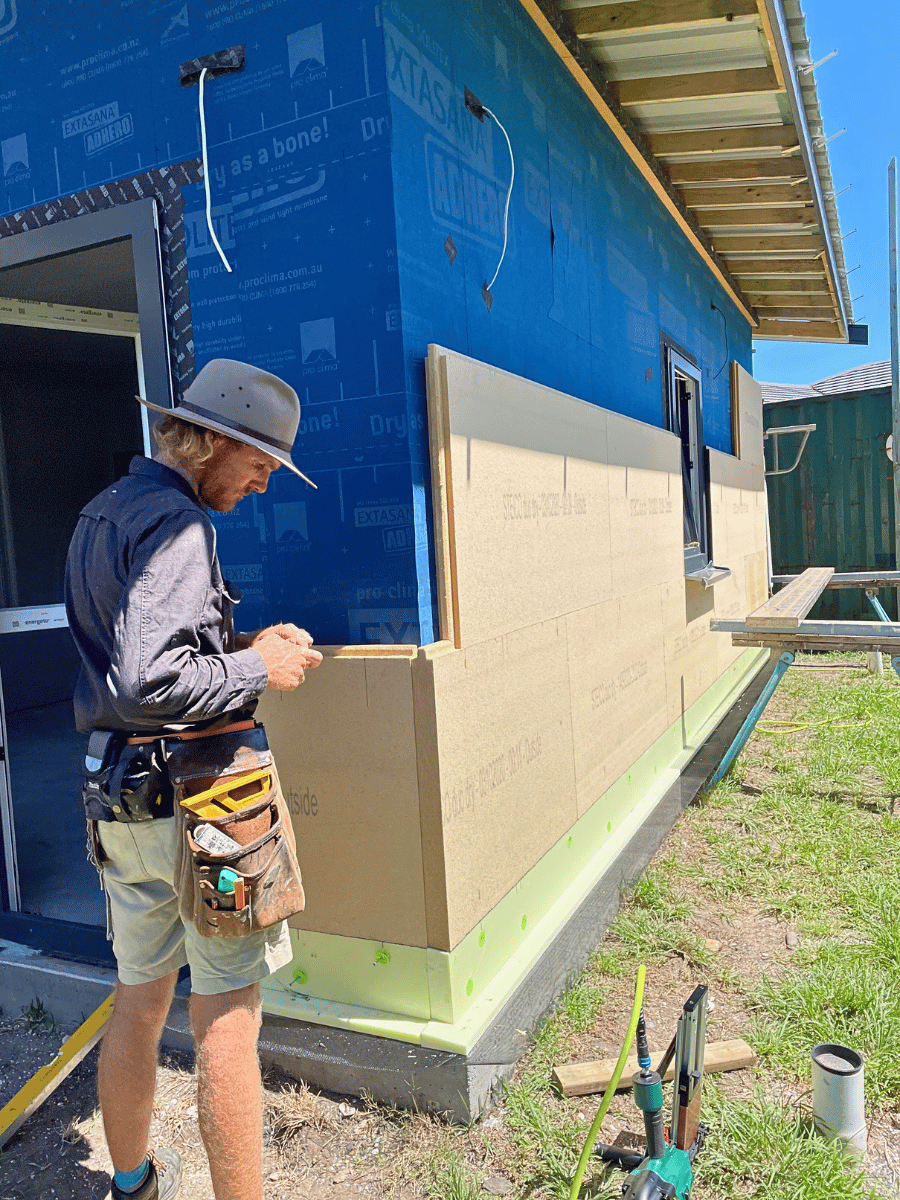
Thermal Bridging and Junction Detailing
A thermal bridge is a path through the envelope with lower thermal resistance than the material around it. Heat takes it, because heat takes the easiest path available.
Thermal bridges cost energy, and more importantly they create cold surfaces where condensation forms. In a building with any moisture load, a cold surface is where mould starts.
Where they occur
Framing. Studs, plates, noggins, lintels. In a typical timber framed wall, framing occupies 15 to 20 percent of the wall area and conducts substantially better than the insulation between it. Steel framing is far worse, conducting hundreds of times better than timber.
Structural penetrations. Balcony slabs, cantilevered beams, steel columns passing from inside to outside. These are the severe ones, because they connect conditioned and unconditioned environments directly through solid material.
Junctions. Wall to floor, wall to roof, wall to wall at corners. Junctions concentrate framing and are where insulation is hardest to install continuously.
Openings. Window and door perimeters, where the frame, the lintel and the sill all interrupt the insulation layer.
Why the condensation risk matters more than the energy
The energy cost of thermal bridging is real but usually modest in an Australian climate. The condensation consequence is disproportionate.
A thermal bridge produces a localised cold spot on the internal surface. If that surface drops below the dew point of the interior air, moisture condenses on it. That happens at the corner of a room, behind furniture against an external wall, or at a window reveal, and the visible result is mould in a location that looks arbitrary until you understand what is behind it.
This is why thermal bridging matters even where the energy target is already met. Surface temperature, not total heat loss, is what determines whether you get a callback.
Reducing thermal bridging
Continuous external insulation. Insulation outboard of the framing, covering the studs rather than sitting between them. This is the most effective single measure, because it addresses the framing fraction directly. Woodfibre and rigid boards are common approaches.
Increased cavity depth. More insulation between studs helps the cavity but does nothing for the framing fraction. It improves the average and not the bridge.
Thermal breaks. Insulating material interrupting a conductive path, used at slab edges, between steel framing and cladding, and at structural penetrations.
Detail avoidance. The cheapest solution is often to not build the bridge. A cantilevered steel beam through the envelope can sometimes be redesigned as two members with a break between them.
The junctions that matter most
Slab edge. The perimeter of a slab on ground is a continuous bridge from the conditioned interior to the outside. Slab edge insulation addresses it.
Wall to roof. Where the ceiling insulation meets the wall insulation, there is frequently a gap at the top plate. Insulation must run continuously over the plate.
Window reveals. The frame interrupts the insulation. Insulating the reveal and detailing the connection strip carefully both reduces the bridge and controls the air path.
Corners. External corners have concentrated framing and are geometrically disadvantaged, losing heat across two faces. They are the most common location for internal surface mould in Australian houses.
Sealing and bridging together
Air leakage and thermal bridging often occur at the same locations, because both follow discontinuities in the envelope.
The junction where a wall meets a roof usually has both a framing concentration and an air path. Fixing one without the other leaves a partial solution. Sealing an air path at a cold junction can make surface condensation worse if the thermal bridge is not addressed, because the moisture that was being carried away by airflow now condenses instead.
Address both at the same detail.
On the drawing
The practical test is to trace the insulation line on a section drawing. If you have to lift your pen, that is a thermal bridge.
It is the same test as the air barrier, on a different layer, and the two lines should generally be able to run together.