
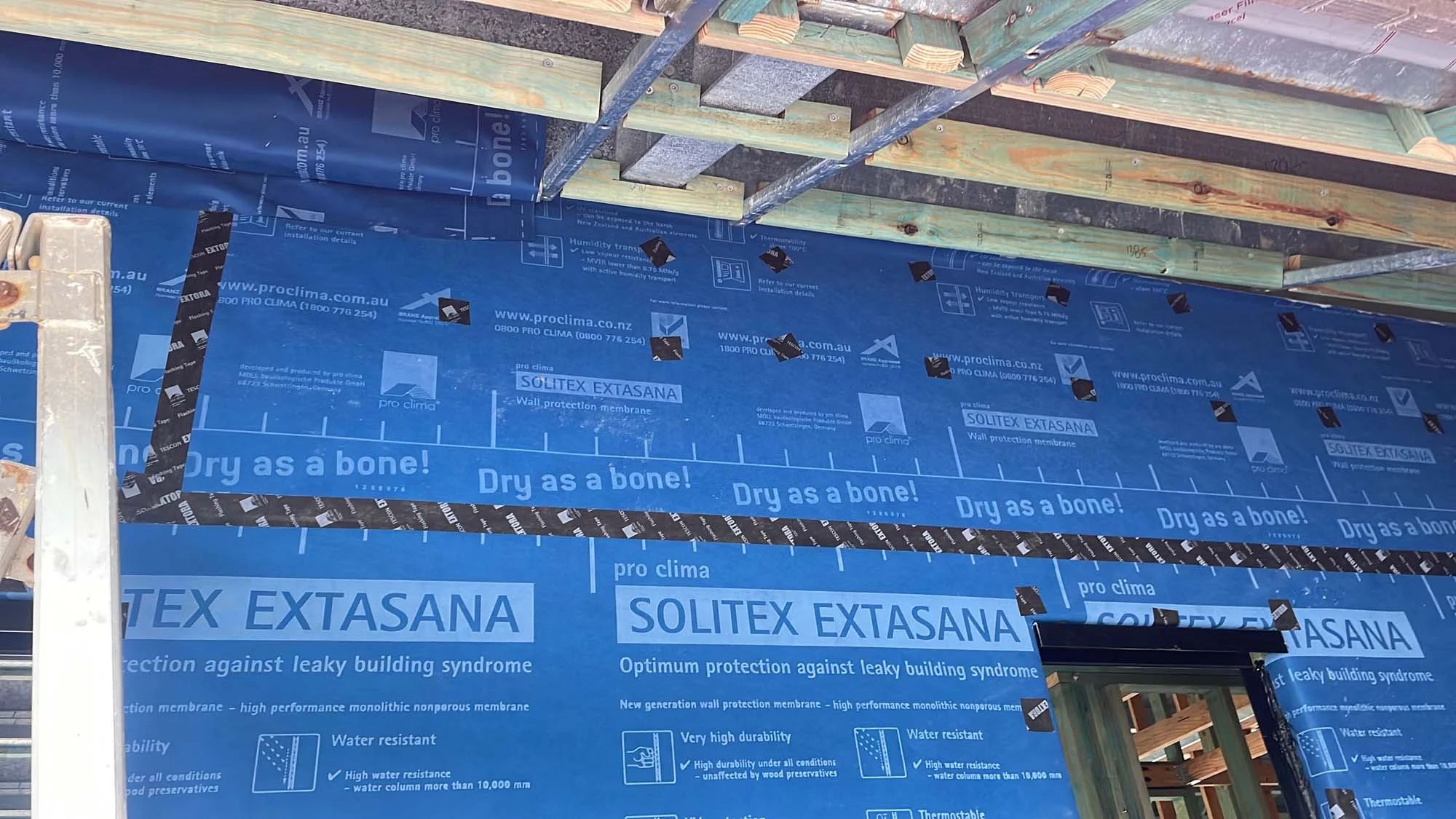
Airtightness and Energy Performance
Airtightness is the performance measure with the largest gap between what is specified and what gets built, because nothing on a drawing tells you whether an assembly will leak and nothing on site tells you either until it is tested.
What is measured
A blower door test pressurises or depressurises the building to 50 pascals and measures the airflow required to maintain that pressure. The result is expressed as air changes per hour at 50 pascals, written ACH50 or n50.
Fifty pascals is roughly equivalent to a 30 kilometre per hour wind on all faces simultaneously. It is a test pressure, not a real condition, chosen because it is high enough to swamp natural pressure differences and produce a repeatable result.
What the numbers mean
- 15 to 25 ACH50. Typical existing Australian housing stock.
- 10 to 15 ACH50. Typical new construction built without attention to air sealing.
- 5 to 10 ACH50. New construction where someone thought about it.
- 3 to 5 ACH50. Achievable with deliberate detailing and no special products beyond proper tapes and membranes.
- 0.6 ACH50. Passive House requirement.
- Below 0.5 ACH50. Exceptional, and requires systematic detailing and testing during construction rather than at the end.
Why it matters for energy
Air leakage moves conditioned air out of the building and unconditioned air in. In a heating climate that is heat leaving. In a cooling climate it is heat and humidity arriving, and the humidity is often the larger load because dehumidification is energy intensive.
The interaction with insulation matters as much as the direct loss. Air moving through insulation carries heat around it, so leakage reduces the effective performance of insulation that is otherwise correctly installed. A building can meet its NatHERS rating on paper and leak enough to undo a meaningful share of the modelled performance.
Why it matters more for moisture
The energy argument is the one usually made. The moisture argument is more important.
Air carries far more water vapour into building assemblies than vapour diffusion does. Diffusion moves vapour through materials slowly. Air movement carries it through gaps quickly and in volume.
That means the air barrier is a more effective condensation control measure than the vapour control layer, and a leaky building with a perfect vapour barrier will still get moisture into the assembly.
Getting a result
Airtightness comes from continuity, not from any single product.
Choose the air barrier plane and mark it on the drawings. Every trade should be able to see where it is.
Make it continuous. Trace it on a section without lifting your pen: wall to ceiling, wall to floor, around every opening.
Seal every penetration as it is made, not at the end.
Test before linings go on. A test at completion tells you the result. A test at lock-up tells you where the leaks are while you can still reach them.
Photograph everything before it is covered.
Testing during construction
The most useful blower door test is not the final one, it is the one done at lock-up when the air barrier is complete and the linings are not.
At that stage smoke, thermal imaging or a hand can find the leaks, and fixing them costs an hour and a roll of tape. The same leaks found at completion cost significantly more, and some cannot be fixed at all.
Where a performance target is contracted, testing during construction is the only reliable way to hit it.
The NCC position
The NCC does not currently set a numerical airtightness target for Class 1 dwellings. What it does require is condensation management, and the provisions around membranes, exhaust and ventilation form part of the same strategy.
Airtightness is where the energy performance actually comes from, and it is one of the cheapest improvements available on a residential build. The material cost of doing it properly is small. The cost is attention.