
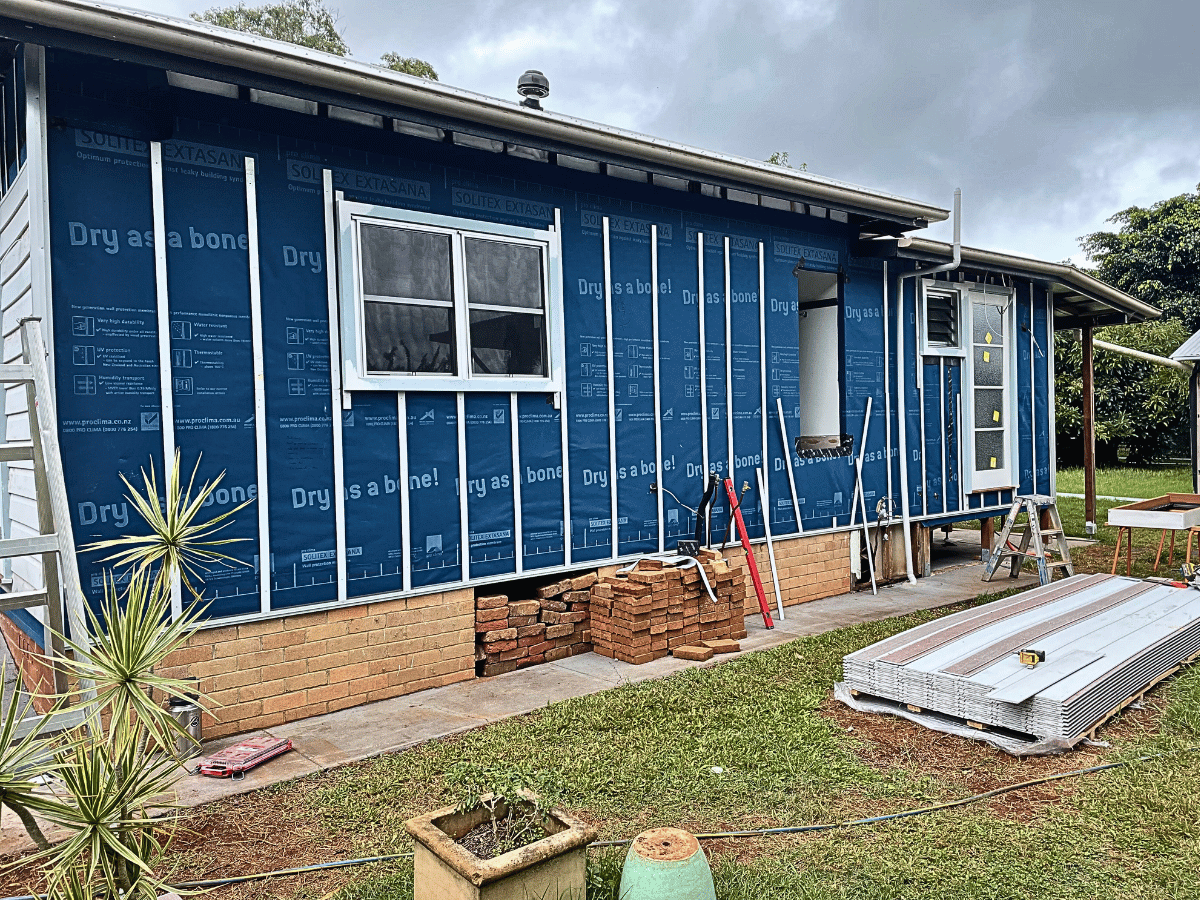
The Four Control Layers
Every external wall does four jobs. It controls water, air, vapour and heat. Most building failures come down to one of those four layers being missing, discontinuous, or in the wrong place relative to the others.
Thinking in control layers rather than in materials is the most useful shift a builder can make, because it turns a wall section into a set of questions you can check on site.
1. Water control
The outermost job. Rain, wind-driven rain and any liquid water that gets past the cladding.
The water control layer is usually the weather resistive barrier behind the cladding, sometimes the cladding itself, and in cavity construction it is the combination of both plus the drainage path.
The test: trace a drop of water from the top of the wall to the ground. If it can get from the outside face to anything water sensitive without a continuous, drained path out, you have a gap.
Where it fails: window and door openings, base of wall terminations, penetrations, and reverse laps.
2. Air control
The air control layer stops air moving through the assembly. It matters more than most builders expect, because air carries moisture, and it carries far more of it than diffusion does.
The air barrier can be on the inside, the outside, or both. What matters is that it is continuous. An air barrier with a hole in it is not an air barrier, it is a partial one, and air will find the hole.
The test: can you draw the air barrier on a section drawing without lifting your pen? Walls to ceiling, walls to floor, around every opening. If you have to lift the pen, that is the leak.
Where it fails: ceiling penetrations, wall-to-ceiling junctions, service entries, window perimeters, and anywhere two trades meet.
3. Vapour control
The vapour control layer manages diffusion: water vapour moving through materials from high concentration to low.
This is the layer most often placed wrongly, because the correct position depends on climate. In a heating-dominated climate the vapour drive runs outward and vapour control sits toward the interior. In a cooling-dominated climate the drive can reverse, and a vapour barrier on the interior becomes a condensing surface.
An intelligent air barrier resolves some of this by varying its permeance with humidity, so the assembly can dry in whichever direction conditions allow.
The test: which way does vapour want to move in this climate, in this season, and can the assembly dry in that direction?
Where it fails: southern wall sections used in northern climates. Vapour barriers installed on both sides of an assembly, which produces a wall that cannot dry either way.
4. Thermal control
The insulation layer. Conceptually the simplest and practically the most compromised.
Insulation only performs at its rated value when it is continuous, at full thickness, in contact with the air barrier, and with no air moving through it. In practice it gets compressed around services, gapped at edges, and bypassed by air movement.
The test: is there any path for air to move from the warm side to the cold side without passing through insulation? Any gap, compression or bypass reduces effective performance.
Where it fails: around penetrations, at edges and junctions, behind services, and wherever insulation is fitted after the services rather than around them.
Order matters
The four layers are not independent. Their relative position determines whether the assembly works.
Water control goes outermost. Thermal control goes between the conditioned and unconditioned sides. Air control can go either side but must be continuous. Vapour control position depends on climate.
Get the order wrong and you can build a wall where every individual layer is specified correctly and the assembly still fails. The most common version is a vapour barrier on the cold side of the insulation, which puts a non-permeable surface exactly where condensation will form.
Using this on site
The value of the control layer framework is that it gives you four questions to ask about any detail:
- Where does water go?
- Where is the air barrier, and is it continuous here?
- Which way can this assembly dry?
- Is the insulation continuous and in contact with the air barrier?
Any junction, opening or penetration that cannot answer all four is a detail that needs resolving before it gets built.
That works at design stage on a drawing and on site with a pencil and the actual wall in front of you, which is where most of these questions actually get answered.