
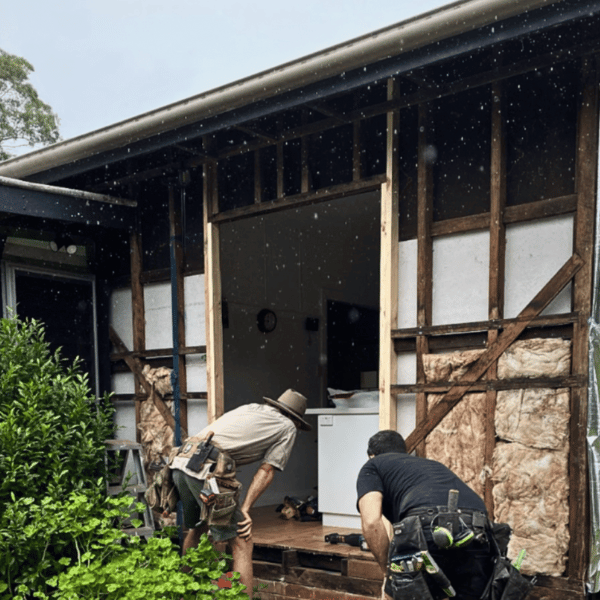
Insulation and Membrane Interaction
Insulation is specified by R-value and installed by whoever is available. The gap between those two facts is where a large share of thermal performance disappears.
Rated versus effective performance
An R-value is measured in laboratory conditions: material at full thickness, no compression, no gaps, no air movement through it. Installed performance is frequently well below that.
Three things cause the gap.
Gaps and compression. Batts cut short, compressed behind services, or fitted around obstacles rather than through them. A small percentage of uninsulated area has a disproportionate effect, because heat takes the easiest path available.
Thermal bridging. Studs, plates, lintels and steel members conduct heat around the insulation. In a timber framed wall the framing fraction is typically 15 to 20 percent of the wall area, and it is conducting at a fraction of the insulation’s resistance.
Air movement. Air moving through or around insulation carries heat with it. Bulk insulation works by trapping still air. Air moving through it defeats the mechanism.
Why the air barrier matters to the insulation
This is the part most often missed on site: insulation and the air barrier are one system.
Bulk insulation does not stop air. It slows it, but air moves through and around it freely enough to carry both heat and moisture. If the air barrier is discontinuous, air moves through the insulation and the insulation’s effective performance drops, regardless of what the batt is rated at.
The practical version: an R2.5 batt in a wall with a leaky air barrier does not deliver R2.5. The specification was met on paper and not in the building.
This is why sealing and insulating are the same job rather than two consecutive ones.
Contact matters
Insulation needs to be in contact with the air barrier for the assembly to work as designed.
Where there is a gap between the insulation and the air barrier, air can circulate in that gap, moving heat around the insulation. Convection loops in the cavity above ceiling insulation are a well documented version of this, and they can substantially reduce effective ceiling performance.
Fit insulation so it fills the cavity fully and touches the layers on both sides.
Insulation and moisture
The insulation layer is also where condensation forms if the assembly is wrong, which makes membrane selection and insulation type interdependent.
Open cell insulation such as mineral wool or glasswool has high vapour permeance. Vapour passes through, so the assembly’s drying behaviour is determined by the membranes rather than the insulation.
Closed cell insulation such as polystyrene and many foil-faced products has low vapour permeance. These materials act as vapour control layers whether or not you intended them to, and their position in the assembly matters as much as a membrane’s.
That is worth knowing under NCC 2022, because the vapour permeance requirement applies to the pliable building membrane, sarking-type material or insulation layer on the exterior side of the primary insulation. A low-permeance insulation product sitting outboard of the primary insulation is captured by the same clause.
Wet insulation
Insulation that gets wet loses performance, and some types do not recover.
Glasswool and mineral wool will dry and largely recover if the assembly can dry. Cellulose and some natural fibre products are more sensitive. Closed cell foams do not absorb water but can trap it against adjacent materials.
The relevant question is not whether the insulation gets wet, since assemblies do get wet, but whether the assembly can dry afterward. That comes back to membrane permeance and cavity ventilation.
What to check on site
- Full thickness, no compression, no gaps at edges or around services.
- In contact with the air barrier on both faces.
- Air barrier continuous and sealed before linings go on.
- Insulation type compatible with the assembly’s drying strategy.
- Services routed so the insulation is not compressed around them.